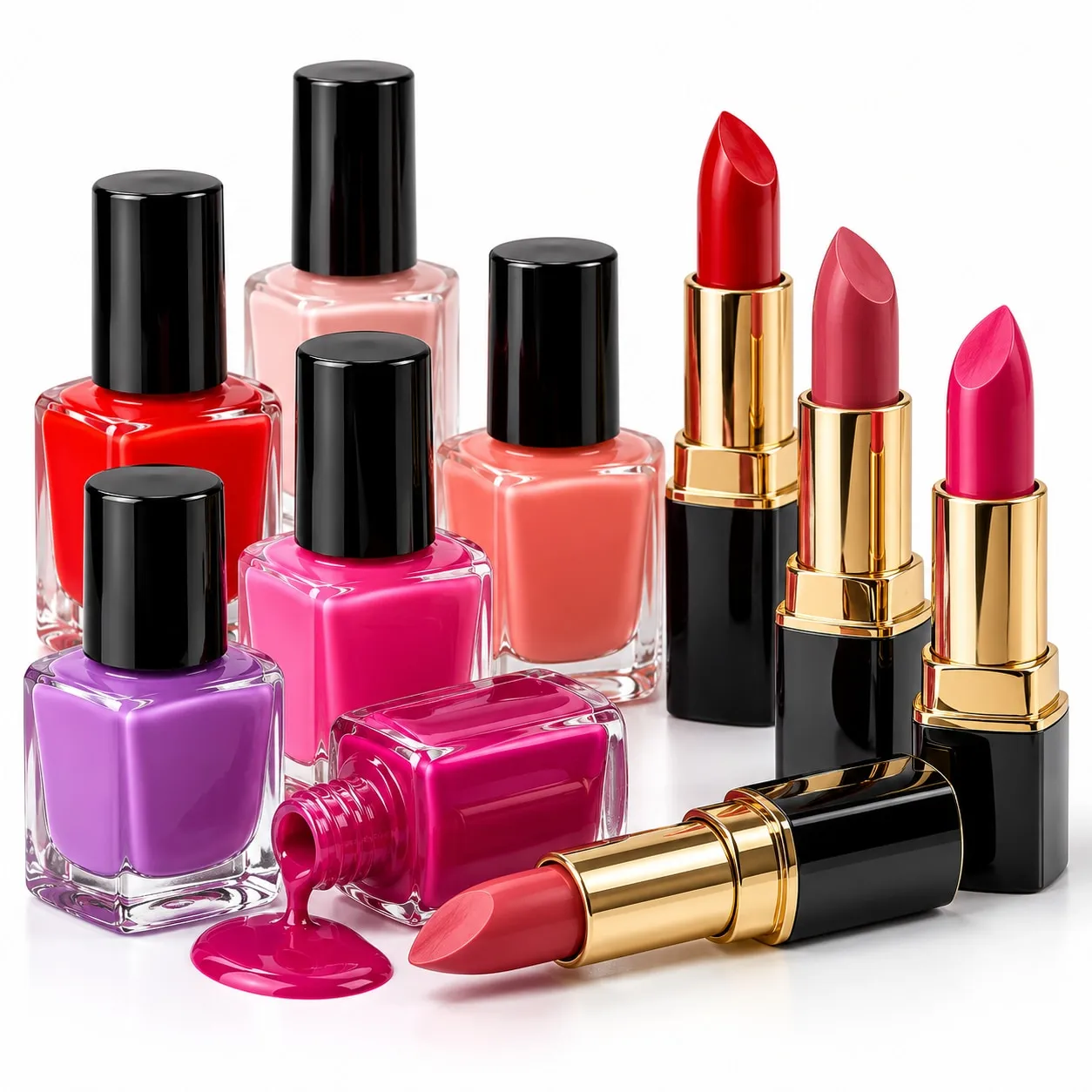
Choosing a private-label range involves more than selecting attractive colours. You need to match each format to its application method, packaging, retail promise, testing requirements and launch budget, then give the manufacturer specifications that can be repeated from one batch to the next.
Key takeaways
- Match nail-polish finishes to the coverage and application your customer expects.
- Limit the first shade range to formats you can test and restock consistently.
- Check formula, brush, closure, label, batch coding and carton samples before approval.
- Compare Delhi suppliers by documentation, sample control, testing and production reliability.
Which Nail-Polish And Lipstick Formats Fit Your Brand?
| Cream | Opaque, usually two coats | Air-dries predictably; easiest application | Everyday retail staple |
|---|---|---|---|
| Sheer | Low opacity, two to three coats | Longer layering time | Natural-look and beginner ranges |
| Shimmer | Medium to opaque, two coats | Similar to cream; particles need even spreading | Finish-led collections |
| Glitter | Sparse to full, two to three coats | Texture dries slower and removes poorly | Occasion and trend ranges |
| Metallic | High opacity, one to two coats | Shows brush marks; needs controlled strokes | Premium, high-impact shelves |
| Magnetic | Medium to opaque, two coats | Hold a magnet over wet polish; difficult to standardise | Demonstration-led retail |
| Gel-effect | Opaque, two coats | Air-dries; thicker film needs careful levelling | Gloss and durability claims |
| Quick-dry | Usually one to two coats | Sets fast, leaving little correction time | Convenience-led ranges |
Conventional solvent-based lacquer air-dries and removes with acetone or remover. Water-based polish also air-dries, often more slowly, and needs water-compatible removal or soaking; retailers expect different wear and packaging performance. UV/LED gel polish requires a lamp, cures in seconds under it, and removes by filing plus solvent soaking.
It is not the low-maintenance choice if customers lack a lamp.
Lip format decides the brand promise:
- Traditional bullet suits coverage-led ranges; liquid matte adds transfer resistance but demands precise application and can feel dry.
- Satin balances pigment and comfort; gloss maximises shine but transfers.
- Tint offers low-maintenance colour with less coverage; lip crayon improves control but needs sharpening or a twist mechanism.
- Balm prioritises comfort and reapplication over durability.
Every added format creates separate filling, packaging, testing, shade and retailer-training work. Define those costs before choosing a private label nail polish and lipstick in Delhi supplier.
How Many Shades Should A First Launch Contain?
Start with 18–24 shades per category, not 40 near-duplicates. A workable launch has 8 core shades, 4 nude-family shades, 3 red-family shades, 3 seasonal shades, 2 tester-only finish shades and 2 demand-testing shades.
This gives enough evidence to identify demand without locking cash into slow-moving stock; adding a metallic, sheer or gloss finish often teaches more than adding another almost identical pink.
1. Define the range by role. Keep core shades year-round, rotate seasonal shades, and use the demand-testing group for colours promoted through samples or limited runs. For custom nail polish and lipstick in Delhi, approve every shade separately; one pigment change can alter viscosity, drying, opacity, transfer and stability.
2. Replace names such as Rose or Wine with a physical master, Pantone reference, CIELAB target, finish reference and agreed colour tolerance. For nail polish, record pigment load, pearl size, opacity, base colour and required coat count. For bullet and liquid lipstick, record undertone, opacity, transfer, staining, feathering and colour after post-application oxidation.
3. Release only against shade-wise samples and batch specifications. Include numerical colour tolerance, fill-weight tolerance, viscosity or hardness, drying or set time, odour, appearance, leakage and packaging-function criteria. A nail polish and lipstick manufacturer in Delhi that cannot reproduce these records leaves you arguing over whether a later batch is “the same.”
What Technical And Packaging Details Prevent A Good Sample From Failing?
A good sample fails when its formula and pack are approved separately. Nail polish requires a defined solvent balance, resin–plasticiser system, pigment dispersion and suspension, plus viscosity, drying time, gloss, adhesion and brush-performance limits. Lipstick requires wax–oil structure, pigment dispersion, payoff, hardness, glide, mould release and bullet strength.
- Nail polish: specify the exact bottle volume, brush width and cut, wiper, cap and bottle material. Test them together for fill weight, flooding, evaporation, leakage, neck fouling, cap seizure, brush swelling or shedding, and solvent compatibility. Do not substitute a cheaper component without repeating validation.
- Lipstick: test the final mould and pack for sweating, oil separation, graininess, bloom, drag, breakage and deformation. A beaker result cannot predict hot-transport behaviour or base failure.
- Give a nail polish lipstick supplier in delhi shade-wise release limits for colour difference, net fill or fill weight, viscosity or hardness, drying or set time, odour, appearance, leakage and packaging function.
| Component | Compare | What failure testing catches |
|---|---|---|
| Nail polish pack | Bottle volume, brush geometry, wiper, cap and glass or plastic material | Evaporation, flooding, leakage, neck fouling and altered application |
| Bullet pack | Bullet diameter and length, mould, stopper, closure and component material | Poor mould release, base breakage, drag, sweating and deformation |
| Liquid lipstick pack | Applicator shape, reservoir, wiper, stopper, closure and compatibility | Overload, leakage, drying, oil separation, graininess and closure failure |
Approve only after the exact formula, shade and final pack pass transport and temperature testing.
What Must You Verify Before Approving Production?
A Delhi facility must pass a regulatory and release check before you approve production. A “nail polish and lipstick manufacturer in Delhi” is not approved merely because its samples look good.
1. Request the Cosmetics Rules, 2020 manufacturing licence, qualified technical staff, testing arrangements and GMP-compliant premises. Confirm whether production uses the manufacturer’s licence, a loan-licence route, or only filling and packing. Private label is a commercial arrangement, not a separate licence category; the route determines manufacturer identity, batch-release responsibility and available records.
2. Check artwork for product identity, shade, manufacturer name and address, batch or lot number, net contents, expiry or use-before date, manufacturing-licence details where applicable, and ingredient declaration. A “marketed by” line does not replace the manufacturer’s regulatory identification.
3. Approve every shade separately with a physical sample and signed specification. Set colour tolerance against the master, plus fill-weight tolerance, viscosity or lipstick hardness, drying or set time, odour, appearance, microbiological limits where relevant, leakage and applicator or closure functionality.
4. Require elevated-temperature, temperature-cycle, humidity and transport testing in the final pack. Room-temperature observation will not expose every failure in a hot warehouse or delivery vehicle.
Release each batch against approved results, not appearance alone. Obtain batch records, retained samples, deviation reports and defined responsibility for complaints, investigation, corrective action and product recall before signing the purchase order.
How Should You Compare Delhi Suppliers And Protect The Launch?
Score a nail polish and lipstick manufacturer in Delhi against an outside-Delhi vendor on process control, not freight distance. Require evidence for each point before comparing quotations.
| Criterion | Delhi supplier | Outside-Delhi vendor |
|---|---|---|
| Licensed product scope | Cosmetics Rules, 2020 licence or documented loan-licence route for both categories | Confirm the same route, manufacturer name and batch-release responsibility |
| Minimum batch size | Record MOQ separately for each shade and format | Add freight, transit time and stock risk to the MOQ calculation |
| Shade development | Ask for shade-wise samples, physical masters and colour-tolerance records | Confirm couriered approvals and sample revision timing |
| Testing | Identify in-house tests or named external laboratory | Check test scope, reports, retained samples and turnaround time |
| Packaging lead time | Confirm component sourcing, artwork approval and packaging validation | Include transit, breakage risk and replacement time |
| Equipment and safety | Verify flammable-solvent storage, ventilation, ignition-source control, filling equipment, heating, pigment dispersion, moulding and cooling | Request photographs, equipment records and the same safety evidence |
| Repeat production | Review batch records, deviations and repeat-shade results | Demand documented change control and comparison samples |
Nail polish needs solvent-compatible equipment and explosion-risk controls. Heated lipstick needs temperature control, dispersed pigments, mould filling, cooling and checks for breakage or deformation; one capability does not prove the other.
Put formula, shade, artwork and mould ownership, exclusivity, MOQ, tooling charges, approval gates, written change-control consent and rework liability in the agreement. Ask SHEEBA COSMETICS INDIA for category-specific licences, batch documents, packaging validation and repeat-batch evidence before choosing private label nail polish and lipstick in Delhi on catalogue samples alone.
Frequently asked questions
Which nail-polish and lipstick formats fit a private-label brand?
Choose nail-polish finishes such as sheer, cream, shimmer or glitter alongside lipstick formats that match your positioning, coverage promise and application experience.
How many shades should a first launch contain?
Set the first shade count according to your testing budget, target customer, packaging minimums and ability to restock proven colours without creating excess inventory.
What technical and packaging details should you check before production?
Check nail-polish opacity, drying behaviour, brush application, sedimentation and closure fit; check lipstick payoff, twist mechanism, bullet integrity, label adhesion and carton details.
What must you verify before approving production with a Delhi supplier?
Approve against a retained sample and confirm the final shade, fill quantity, packaging components, batch coding, ingredient and label information, lead time and quality-control records.
Related products
 | Nail Polish Sheeba Cosmetics Sheeba Cosmetics offers a premium range of Nail Polish & Lipstick designed to enhance your beauty with vibrant colours, smooth... View product → |
 | Nail Polish Nail Polish Color – Sheeba Cosmetics Sheeba Cosmetics offers a premium collection of Nail Polish Colors designed to enhance the beauty of your nails... View product → |
 | Nail Polish & Lipstick – Sheeba Cosmetics Sheeba Cosmetics offers a premium range of Nail Polish & Lipstick designed to enhance your beauty with vibrant colours,... View product → |
 | Nail Polish Sheeba Cosmetics Sheeba Cosmetics offers premium quality Nail Polish Lacquer designed to give nails a smooth, glossy, and long-lasting finish. View product → |
 | Nail Polish Sheeba Cosmetics Sheeba Cosmetics offers a vibrant range of ColorFul Nail Polish designed to give your nails a bright, stylish, and attractive look. View product → |
 | Liquid Lipstick Premium Liquid Lipstick Manufacturing by Sheeba Cosmetics 📍 T-2/199, Mangolpuri Industrial Area, Phase-1, New Delhi – 110083 At Sheeba Cosmetics, we... View product → |
Keywords