A first enquiry is only the start: the manufacturer still needs a usable brief, a defined formula route, packaging information and a realistic launch date before it can quote or make samples. By the end, you will know which documents, approvals, checks and line items should move your project from an email to a released batch.
Key takeaways
- Send shade, finish, pack, order quantity and launch date in your first brief.
- Ask for the manufacturer’s licence copy, ingredient list and product specifications.
- Test shade accuracy, pay-off, texture, stability, packaging fit and microbiological safety.
- Compare quotes by formula, minimum order, testing, packaging, lead time and payment terms.
What does a lipstick OEM ask for after your first enquiry?
Prepare a usable brief before contacting a lipstick OEM in Delhi. “Private-label lipstick” is not enough to produce a meaningful quote; the supplier needs to know what you want made, where it will be sold and when it must launch.
- State the product type, finish, target shade or shade count, coverage, pay-off, glide and fragrance preference.
- Give the pack format, such as a standard bullet case or custom component, plus decoration requirements and whether you already have artwork.
- Specify the target quantity, expected annual volume, target cost per unit and preferred minimum order quantity.
- Identify the regulatory market, launch date and any claims you plan to make, including “long-lasting,” “vegan” or “transfer-proof.”
- Ask whether the supplier formulates, manufactures, fills, packs and releases the batch at its own site, or subcontracts any step.
The first response should confirm receipt, identify a technical or commercial contact and flag missing information instead of sending a generic catalogue. It should also name the actual manufacturing-site address: a Delhi-based supplier may produce in Delhi, Haryana or Uttar Pradesh, and the cosmetics licence applies to the premises making the lipstick.
Ask for a written product-development sheet covering the agreed brief, proposed formula route, sample timeline, minimum order, testing scope and quotation assumptions. That document gives you something specific to correct before development begins.
How does an enquiry become a formula, compliance and commercial brief?
The manufacturer decides by matching your required finish, shade range, pay-off, glide, fragrance, pack format, target cost, annual volume, market and launch date against a proven base. The result belongs in a written product-development sheet, not a verbal promise.
| Option | What it means | When it applies |
|---|---|---|
| Stock formula | An existing base and shade system used without technical change | Your finish, coverage, performance and target cost already match |
| Modified base | A proven formula adjusted for shade, pigment load, fragrance, texture or pay-off | You need a controlled change without creating the product from zero |
| New formulation | A fresh development with new raw materials, performance targets or format | The brief demands unusual wear, comfort, ingredients or a capability the existing bases cannot deliver |
Stock development is usually fastest and simplest to quote. A modification adds trials, compatibility checks and possible minimum-volume or cost changes; a new lipstick requires more development work and carries greater scale-up risk.
The brief must also identify the exact manufacturing site, target market, packaging format, quantity and launch date. For private-label lipstick production in India, request the site’s Cosmetics Rules, 2020 licence: Form COS-8 for a manufacturing licence or Form COS-9 for a loan licence.
A Delhi sales office does not prove that the listed factory makes your batch.
Commercial terms must state who owns the formula, shade records and artwork; whether the formula is exclusive; whether the OEM can sell the base elsewhere; and who pays for tooling, unused components and obsolete printed packs. Approve this document before sample work begins.
What happens between the approved brief and the first lipstick sample?
Once the brief is approved, the first sample follows a controlled development sequence, not a direct jump from formula sheet to finished lipstick. The practical lipstick OEM manufacturing process in Delhi usually runs as follows:
1. Confirm the formula route and specification. The manufacturer selects a stock base, modifies an existing base or starts a new formula against the approved finish, shade, coverage, glide and target cost. Record the formula reference, pigment percentages and processing temperatures before making the lab batch.
2. Build the shade through pigment dispersion. Pigments are wetted into part of the oil phase and milled or dispersed until no visible specks or streaks remain. Poor dispersion causes uneven colour, drag and weak pay-off even when the raw-material list looks correct.
3. Check packaging compatibility alongside the formula. Test the bullet in the proposed mould and case for dimensions, twist-up clearance, base fit, scraping and cap closure. A case ordered before this check can force rework or leave you with unusable components.
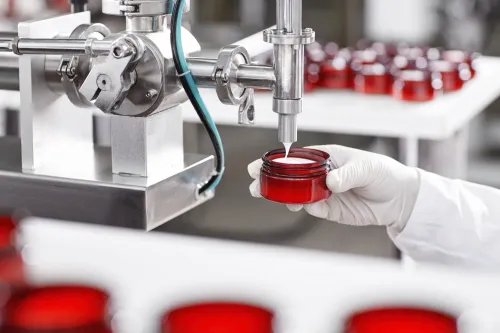
4. Run a documented pilot or engineering batch. Heat waxes and oils, add ingredients in the specified order, control shear and hold time, then deaerate the bulk. A laboratory formula can change viscosity during scale-up, so compare the kettle batch with the approved lab reference.
5. Fill and finish the sample. Transfer the hot mass into moulds, cool it, remove the bullets, flame-treat or surface-finish them when specified, then assemble, label and pack the units. Keep the pilot record and retention sample; they provide the reference when the first sample needs adjustment.
What exactly must you test before approving a lipstick sample?
Approve a lipstick sample only after it passes five separate gates; a colour match alone can hide poor payoff, packaging damage or instability.
1. Shade: Compare the applied stick with the approved physical standard under daylight and indoor lighting. Check undertone, opacity, buildability and colour after drying, then record the acceptable variation for every production batch.
2. Application: Test glide, drag, payoff, evenness, feathering, patchiness, fragrance and mouthfeel on clean lips. Apply one coat and three coats; a shade that needs excessive layering is not equivalent to the approved sample.
3. Packaging fit: Fill pilot units and operate the twist mechanism repeatedly. Check bullet alignment, collar scraping, cap closure, case-to-bullet separation, leakage, twist-up failure and decoration rub resistance against approved packaging samples and dimensional tolerances.
4. Stability: Inspect retained units for oil sweating, wax bloom, graininess, pigment settling, colour drift, fragrance change, cracking, deformation and loss of payoff. Ask how elevated-temperature results relate to real-time stability and packaging compatibility; heat screening alone does not prove shelf life.
5. Performance: Use a written wear protocol to assess transfer, rub-off, wear duration, comfort, bullet strength and breakage during use. Repeat the test after agreed storage exposure.
Sign approval against a numbered specification, not an email saying “looks good.” Before release, request the batch number, manufacture date, certificate of analysis or release record, quantity reconciliation, packaging inspection results and agreed performance data. Keep retention samples and document the complaint, deviation, recall and change-notification procedure.
How do you compare the quotation and release the finished batch?
A low unit price can hide mould charges, pigment-matching fees, artwork setup, testing, cartons, GST, freight, wastage and the cost of unused packaging. Compare quotations on the same shade count, order quantity, pack specification and delivery point.
| Option | Confirm in writing | Why it matters |
|---|---|---|
| Ex-works | You arrange pickup, insurance and freight | The quoted price is not your delivered cost |
| Delivered | Freight, GST and unloading are itemised | You can compare landed cost |
| Formula ownership | Manufacturer, buyer or shared ownership | You need permission to transfer or reproduce it |
| Custom mould | Who pays and owns the mould | A paid mould is not automatically yours |
| Stock formula | Existing base with agreed specification | Faster, but exclusivity may not apply |
Before placing an order, ask for:
- The cosmetic manufacturing licence for the exact factory premises, not merely the Delhi sales address; a Delhi supplier may manufacture in Haryana or Uttar Pradesh, and the state licensing authority ties the licence to that site.
- The approved formula or specification reference, shade standard, batch size, minimum order quantity, payment milestones and change-notification terms.
- Batch-specific certificate of analysis or release record, batch number, manufacture date, quantity reconciliation, packaging inspection record and agreed stability or performance data.
- Dispatch terms covering seal condition, carton count, transport damage, retention samples, complaint handling, deviations, recalls and delivery documents.
SHEEBA COSMETICS INDIA should be asked the same site-licence and batch-release questions as any lipstick manufacturing company in Delhi. Release payment only after the finished batch passes the agreed criteria and the document pack matches the cartons.
Related products
 | Lipstick Lipstick Manufacturing at Sheeba Cosmetics T-2/199, Mangolpuri Industrial Area, Phase-1, New Delhi – 110083 Introduction At the intersection of beauty... |
 | Nail Polish Sheeba Cosmetics Sheeba Cosmetics offers a premium range of Nail Polish & Lipstick designed to enhance your beauty with vibrant colours, smooth... View product → |
Frequently asked questions
What does a lipstick OEM ask for after your first enquiry?
Expect questions about the lipstick type, shade range, finish, target price, packaging, order quantity, sales market and launch date. Provide reference samples, shade codes or Pantone references when available.
How does an enquiry become a formula, compliance and commercial brief?
The OEM converts your product idea into a written brief covering the formula, ingredients, shade and finish, pack components, testing, labelling, order quantity, price and delivery timeline. Review each item before development begins.
What happens between the approved brief and the first lipstick sample?
The manufacturer selects or develops a formula, matches the shade, checks component compatibility and prepares a laboratory sample. You then review the sample against the agreed finish, texture, pay-off, packaging and shade target.
What exactly must you test before approving a lipstick sample?
Check shade accuracy, application, pay-off, drag, comfort, fragrance, breakage, melting, sweating, bullet hardness, twist-up performance and packaging fit. Request stability, microbiological and safety documentation where relevant.
How do you compare the quotation and release the finished batch?
Compare the full scope rather than the unit price: minimum order quantity, formula, packaging, testing, artwork, taxes, freight, lead time, payment terms and rejection process. Approve a signed specification and retain the approved sample as the batch reference.
Related products
 | Liquid Lipstick Premium Liquid Lipstick Manufacturing by Sheeba Cosmetics 📍 T-2/199, Mangolpuri Industrial Area, Phase-1, New Delhi – 110083 At Sheeba Cosmetics, we... View product → |
 | Start Your Own Cosmetic Brand Start Your Own Cosmetic Brand in India with Sheeba Cosmetics Starting your own cosmetic brand in India has never been easier. View product → |
Keywords